A Museum Morning with One Room in Mind
Plan a museum morning around one gallery, with a simple route, practical fallback choices and a note-taking method that leaves you with a sharper memory.
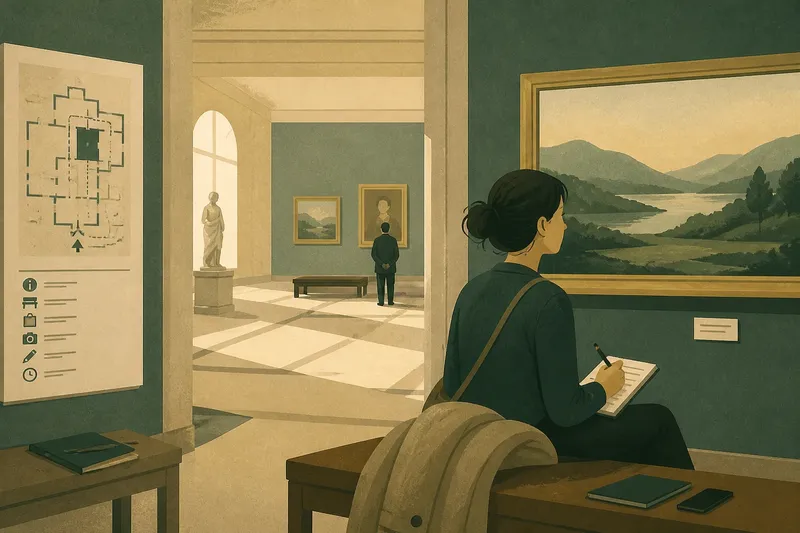
You are holding your coat while the museum floor plan offers six wings. A museum morning with one room in mind starts by choosing a gallery that gives you a reason to come in, then making a few practical decisions around it. The point is not to stay put at all costs; it is to give the visit a shape that survives a closed door, a crowd or a change of interest.
How do you choose the room?
Choose for something specific: a painting you have wanted to see, a room of carved stone, a period interior, or a display of local photographs. A clear reason makes it easier to decide what deserves your attention once you arrive.
Check the museum website for opening hours, temporary closures and the current floor plan. Note the gallery’s name, its location and the nearest entrance. If the building is large, identify a bench or public seating area as well. These details prevent a visit from beginning with a prolonged debate beside the ticket desk.
Make a fallback choice that suits the same interest or offers a different kind of room. If a gallery is closed, a nearby display of related objects may do; if it is crowded, a quieter room with seating may be more useful. The alternative should make the decision easier, not create a second route to complete.
What should you check before setting off?
A quick check of practical details can prevent avoidable friction. Use this list to decide what to do if the plan meets a snag:
- Observation: the museum website lists the chosen gallery as open; if it is open, keep it as your first destination, but if it is closed, use the named alternative or ask staff for a nearby option.
- Observation: the floor plan shows a clear route from your entrance; if it does, note the route, but if it does not, check the museum map on arrival rather than guessing through staff-only areas.
- Observation: the rules permit your bag in the galleries; if they do, carry only what you need, but if they do not, use the museum’s designated storage or leave the bag elsewhere before entering.
- Observation: photography or sketching is permitted in the room; if it is, follow any limits shown on signs, but if it is not, use a small notebook and pencil if those are allowed.
- Observation: the visit has a fixed departure time; if it does, set an alarm or note the time before you enter, but if it does not, leave the schedule open and choose your next move when ready.
- Observation: the room has seating or a nearby public bench; if it does, use it for a pause, but if it does not, choose a place to rest elsewhere rather than standing until your attention fades.
Pack accordingly. A small notebook and pencil can help if writing is allowed; a phone can hold a reminder or a photograph of a label where photography is permitted. Comfortable shoes are useful for standing and walking. The museum’s own rules settle questions about bags, photography and sketching.
What can you notice once you arrive?
Pause in the entrance hall long enough to notice the building’s first impressions: daylight, echoes, the direction people are moving. Then find the gallery you chose. Treat the route as a way to get there, not another task to tick off.
Inside, take in the room as a whole before choosing an object. Notice the doorway, the benches and the arrangement of displays. A gallery is not just a container for its collection; its layout affects what catches the eye and where people gather.
Choose one object or a small group. Look from a little distance, then attend to details you can see from where visitors are allowed to stand. Read the label after forming a few observations. That order lets the label add context instead of deciding in advance what you should notice.
Say you choose a room of landscape paintings because you want to understand how distant hills are made to seem far away. You look at the horizon in two paintings, then compare how colour and detail change towards the distance. The result is a specific observation about the painters’ choices, not a requirement to rank the works or see every picture.
What if the room is crowded or closed?
If visitors gather around an object, look from the edge and wait for a clear view rather than pushing into the group. Move aside when someone needs access to a label or display. If the room feels too busy, take a pause in a public area and decide whether to return or use your alternative.
If the gallery is closed, ask staff whether a related room is open, or use the fallback you chose before setting off. A changed plan does not need to become a hurried attempt to cover the building. Museum staff can also clarify access, seating and local rules; follow their guidance around barriers and fragile objects.
What should you do after the visit?
Before leaving the gallery, write down one detail and why it stayed with you. It might be a painted edge, a bench facing a window, or a label that altered your first impression. A note is like a bookmark: it helps you return to one page without pretending to contain the whole book.
If another room now interests you, ask what it would add. A neighbouring display might answer a question about the material or subject; a quieter room might offer a welcome change of atmosphere. If there is no clear reason to continue, leave. A visit can be complete without becoming a tour of every wing.
Before you go, check the time and any practical arrangements for leaving, such as collecting a stored bag. A short note on what you noticed can be more useful later than a list of room names, especially if the building’s corridors have already begun to blur together.
What questions come up when planning a museum morning?
How do I choose a gallery?
Pick one with a subject, object or architectural quality that interests you. Check that it is open and name an alternative before setting off.
How long should I stay in one room?
Stay while you are interested and able to look comfortably, then pause or move on. Crowding, seating and your own attention matter more than a fixed duration.
Should I read every label?
No. Read labels that answer a question or add context to something you have noticed. This keeps reading connected to the objects rather than turning it into a separate assignment.
What if I want to see another gallery?
Go if it offers a clear change of subject, atmosphere or context, and if you have time to enjoy it. Otherwise, leave with the detail you chose to remember rather than adding rooms by default.
On the way out, keep the note somewhere you can find it again. One precise detail can bring back the room’s light, arrangement or atmosphere more readily than a full itinerary, and it gives you a useful starting point if you return to the museum another day.